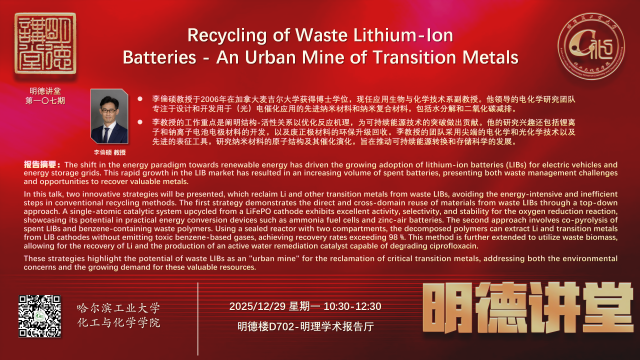
应刘宇艳教授邀请,香港理工大学副教授李倫硕教授到我校进行学术访问,并开展化工与化学学院“明德讲堂”学术报告,欢迎广大师生参加。
报告题目:Recycling of Waste Lithium-Ion Batteries - An Urban Mine of Transition Metals
报告时间:2025年12月29日(星期一)08:30-10:30
报告地点:明理学术报告厅(明德楼D702)
报告摘要:
The shift in the energy paradigm towards renewable energy has driven the growing adoption of lithium-ion batteries (LIBs) for electric vehicles and energy storage grids. This rapid growth in the LIB market has resulted in an increasing volume of spent batteries, presenting both waste management challenges and opportunities to recover valuable metals.
In this talk, two innovative strategies will be presented, which reclaim Li and other transition metals from waste LIBs, avoiding the energy-intensive and inefficient steps in conventional recycling methods. The first strategy demonstrates the direct and cross-domain reuse of materials from waste LIBs through a top-down approach. A single-atomic catalytic system upcycled from a LiFePO cathode exhibits excellent activity, selectivity, and stability for the oxygen reduction reaction, showcasing its potential in practical energy conversion devices such as ammonia fuel cells and zinc-air batteries. The second approach involves co-pyrolysis of spent LIBs and benzene-containing waste polymers. Using a sealed reactor with two compartments, the decomposed polymers can extract Li and transition metals from LIB cathodes without emitting toxic benzene-based gases, achieving recovery rates exceeding 98 %. This method is further extended to utilize waste biomass, allowing for the recovery of Li and the production of an active water remediation catalyst capable of degrading ciprofloxacin.
These strategies highlight the potential of waste LIBs as an urban mine for the reclamation of critical transition metals, addressing both the environmental concerns and the growing demand for these valuable resources.
报告人简介:
李倫硕教授于2006年在加拿大麦吉尔大学获得博士学位,现任应用生物与化学技术系副教授。他领导的电化学研究团队专注于设计和开发用于(光)电催化应用的先进纳米材料和纳米复合材料,包括水分解和二氧化碳减排。
李教授的工作重点是阐明结构-活性关系以优化反应机理,为可持续能源技术的突破做出贡献。他的研究兴趣还包括锂离子和钠离子电池电极材料的开发,以及废正极材料的环保升级回收。李教授的团队采用尖端的电化学和光化学技术以及先进的表征工具,研究纳米材料的原子结构及其催化演化,旨在推动可持续能源转换和存储科学的发展。